News
New 5DAIS Publication: Two decades of intermittent regrounding beneath Pine Island Glacier
We are pleased to share a new publication from members of the 5D Antarctica team and collaborators:
Surawy-Stepney, T., Wallis, B.J., Hogg, A.E. et al. The dynamic response of Pine Island Glacier to two decades of intermittent ice shelf regrounding. Nat Commun 17, 9183 (2026).
Pine Island Glacier is one of Antarctica’s fastest-changing glaciers and a major contributor to global sea-level rise. This new study combines satellite observations with numerical modelling to investigate how periods of intermittent regrounding beneath the glacier’s floating ice shelf have influenced its behaviour over the past two decades.
The authors found that when parts of the ice shelf temporarily reconnected with the seafloor, the resulting increase in resistance to ice flow was relatively small. However, these regrounding events may have played an important role in triggering fractures, or rifts, within the ice shelf. The development of these rifts is linked to subsequent glacier acceleration and changes in ice dynamics.
The findings provide new insights into the complex interactions between ice shelves, the ocean, and the seafloor, improving our understanding of the processes that control the stability of Pine Island Glacier and its future contribution to sea-level rise.
Read the paper here: https://doi.org/10.1038/s41467-026-75648-8
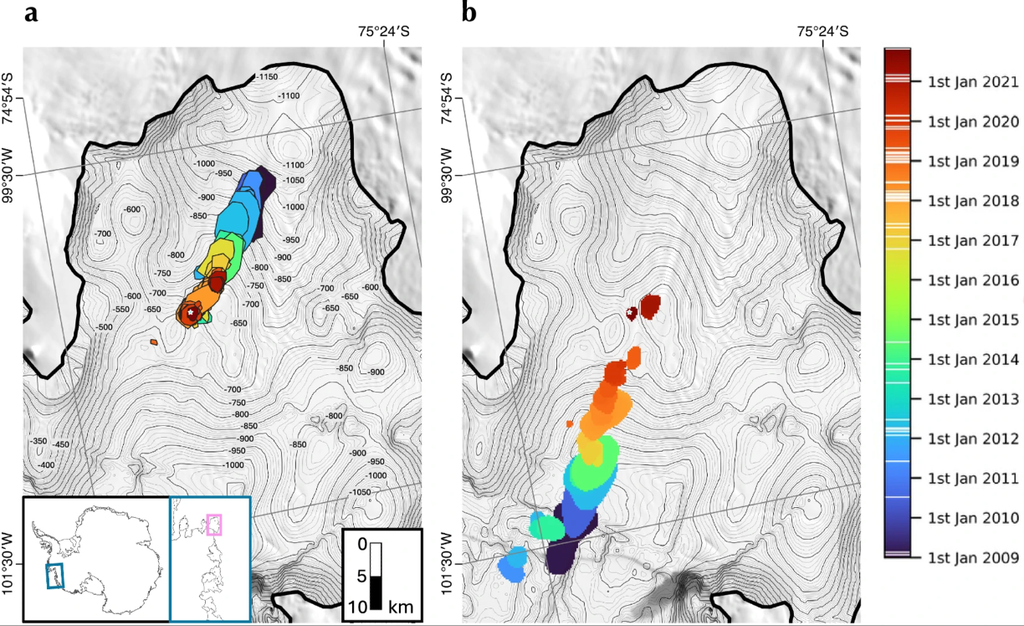
Spatiotemporal evolution of the regrounding of Pine Island Ice Shelf, from Surawy-Stepney et al. (2026).
New 5DAIS Publication Investigates Melting of Pine Island Ice Shelf
We are pleased to share a new publication from members of the 5D Antarctica team and collaborators:
Lowery, K., Holland, P. R., Dutrieux, P., Hogg, A. E., & Gourmelen, N. (2026). Drivers of Basal Melt Variability for Pine Island Glacier Ice Shelf: Ocean Forcing Versus Geometric Feedback. Geophysical Research Letters.
The study, published in the journal Geophysical Research Letters, investigates the factors controlling melt beneath the floating ice shelf of Pine Island Glacier, one of Antarctica’s largest contributors to sea-level rise. Using ocean model experiments constrained by observations between 2011 and 2021, the researchers separated the effects of changing ocean conditions from changes in ice-shelf geometry.
Their results show that variability in ocean conditions was responsible for the vast majority of changes in basal melt rates, accounting for around 82% of the observed variability, while changes in ice-shelf geometry contributed only about 8%. However, geometric changes remain important because they alter ocean circulation beneath the ice shelf, affecting where melting occurs and potentially influencing glacier stability through changes in ice-shelf buttressing.
These findings improve our understanding of the processes driving Antarctic ice loss and help clarify the relative roles of ocean forcing and glacier evolution in shaping the future of Pine Island Glacier.
Read the paper here: https://doi.org/10.1029/2025GL121404
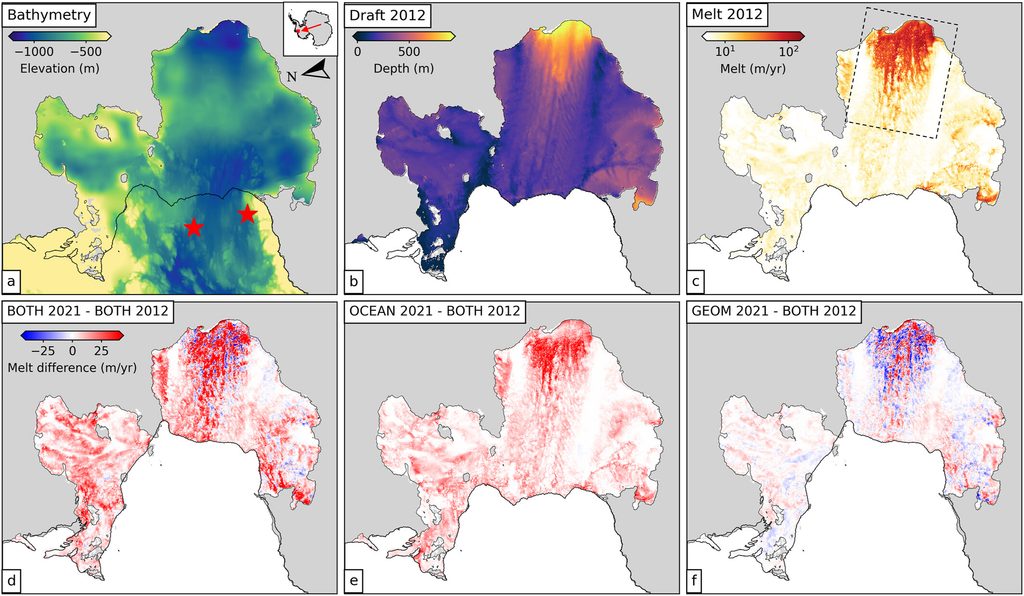
Modelled ice shelf basal melt rates from Lowery et al. (2026).
New 5DAIS Publication Looks at Melting Snow in Antarctica
We are pleased to share a new publication which helps our understanding of surface melting across Antarctica:
Leduc-Leballeur, M., Picard, G., Zeiger, P., and Macelloni, G.: Empirical classification of dry-wet snow status in Antarctica using multi-frequency passive microwave observations, The Cryosphere, 20, 1199–1216, 2026.
Scientists often use satellite measurements to detect whether snow on the Antarctic Ice Sheet is wet or dry. However, most existing methods provide only a simple yes-or-no answer, which can miss important details about how melting and refreezing occur within the snow.
In this study, published in the The Cryosphere, researchers combined satellite observations collected at different microwave frequencies and at different times of day. Because each frequency can “see” to a different depth within the snowpack, the new approach provides a much richer picture of snow conditions from the surface down to more than a metre below.
Using this information, the team identified 10 different snowpack states that describe whether the snow is dry, actively melting, refreezing overnight, or retaining liquid water beneath the surface. The method was tested across Antarctica using data from 2012 to 2023 and was found to reliably capture patterns of seasonal melting and refreezing.
This new classification provides a more detailed way to monitor Antarctic snow conditions, helping scientists better understand extreme melt events, seasonal changes, and the impacts of a warming climate.
Read the paper here: https://doi.org/10.5194/tc-20-1199-2026
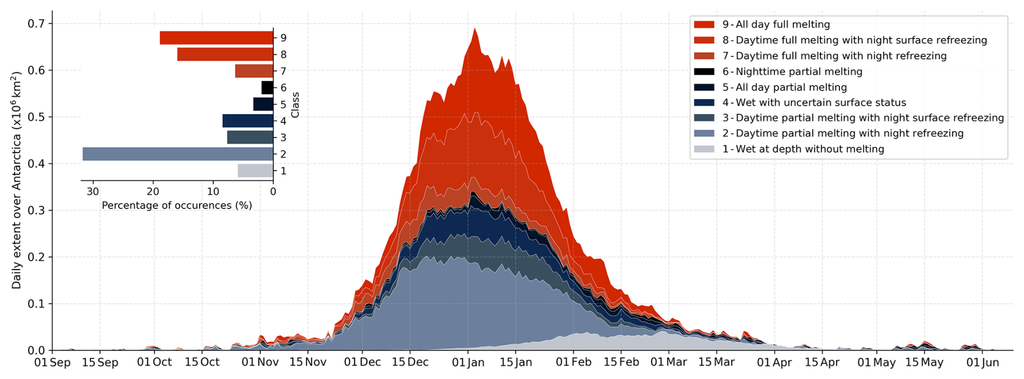
Daily extent of each snowpack status over Antarctica from September to June on average over 2012–2023. The percentage of occurrences of each class over this period is shown in the upper left inset plot (Leduc-Leballeur et al.; 2026).
Kickoff Meeting
The ESA Dynamic 5D Antarctica (5DAIS) project formally kicked off on the 27th November 2024, led by Prof Anna Hogg, and supported by the European Space Agency and the project team. The international consortium is made up of 7 research institutions from 4 countries across Europe, and the whole team were excited to begin work on this project which is part of the ESA Polar Science Cluster. During the Kick off meeting we had good discussions about the science plan, the suite of Earth Observation datasets that will be generated and we planned the next steps of the project. Stay tuned for more news from the 5DAIS team!